
Objective Assessment in Stroke Rehab: The Power of Precision Data
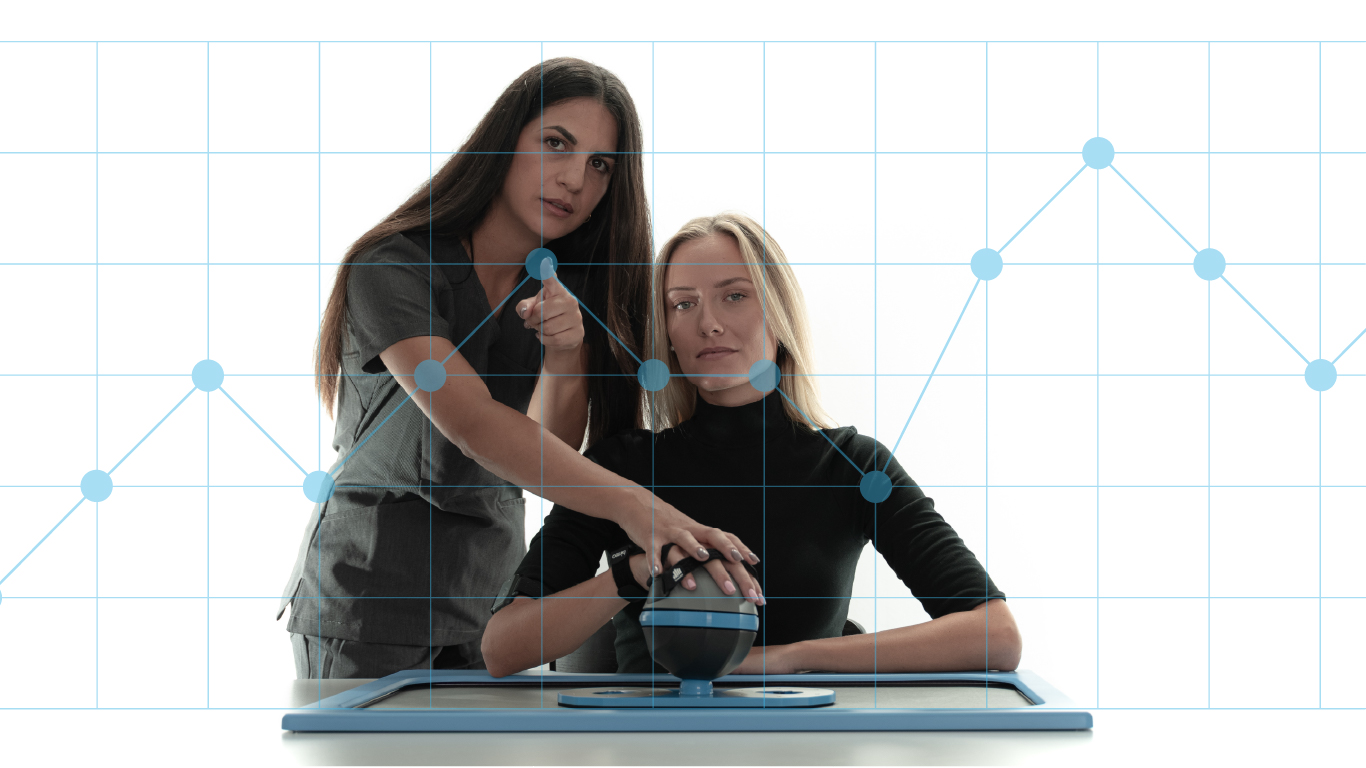
Why Objective Data is the New Gold Standard in Neurological Rehabilitation
In traditional neurological physical therapy, progress is often measured by what a clinician can see with the naked eye. While expert observation is invaluable, the future of recovery lies in objective assessment, using sensors to capture the subtle physiological changes that define true recovery.
By integrating advanced technology, we move away from “it looks better” to “it is 18% smoother,” providing both patients and clinicians with the measurable proof of progress.
1. Upper Limb Assessment: Beyond the Reaching Task
When evaluating an arm or shoulder after a stroke, we no longer just look at whether a patient can reach a target. We look at how they reach it.
Movement Smoothness (Jerk Analysis)
Healthy movement is fluid. In neurological recovery, “jerkiness” is a sign of poor motor control. Using systems like Bimeo, we can quantify movement smoothness. This data reveals if the brain is successfully reorganizing the neural pathways required for coordinated motor output.
Path Deviation
Does the patient reach in a straight line, or is there a wide arc (deviation)? By measuring the exact trajectory of a limb, we can identify compensatory movements, where a patient “cheats” by using their back or neck, and correct them in real-time.
2. Balance and Posture: Mapping the Center of Gravity
Balance is a complex internal calculation. Objective assessment allows us to see the “invisible” shifts in weight that lead to falls.
Static Weight Distribution
Many stroke survivors unknowingly favor their non-affected side, leading to muscle atrophy and joint strain. A sensor-based platform like Equio provides a digital map of weight distribution, showing exactly how much pressure is being applied to each limb.
Limits of Stability (LoS)
How far can a patient lean in any direction before losing their balance? Objective testing measures the Limits of Stability. By quantifying this “safety zone,” therapists can safely push the boundaries of a patient’s balance without increasing the risk of a fall.
3. The Critical Need for Tech Integration
Why is it so important to integrate technology like motion tracking and postural sensors into daily clinical practice?
- Sensitivity to Change: Sensors can detect improvements of 1–2% that a human eye might miss. This “micro-progress” is vital for maintaining patient motivation during long recovery cycles.
- Standardized Reporting: Data provides an unbiased record for insurance providers and doctors, proving that the chosen intervention is working.
- Personalized Protocols: When we know exactly where the “deviation” occurs, we can tailor the exercise to the millimetric needs of the patient.
The 2026 Perspective: In an era of precision medicine, subjective scales (like the Berg Balance Scale) are being augmented by continuous, sensor-based monitoring to ensure no patient is left behind.
📺 See the Data in Action
Curious about what a “movement smoothness” graph actually looks like? Watch our video here where we take you behind the scenes of a real assessment session and show you the data screens our therapists use to track recovery.
READY TO LEARN MORE
ABOUT OUR TOOLS?