Stroke (CVA) Recovery: Understanding Pathophysiology and the Future of Rehab
From Crisis to Clinical Success: Navigating Stroke (CVA) and Sensor-Based Rehabilitation
A Cerebrovascular Accident (CVA), commonly known as a stroke, remains one of the leading causes of long-term disability worldwide. It occurs when the brain’s blood supply is interrupted, leading to rapid neuronal death.
However, the narrative of stroke is shifting from “permanent loss” to “active recovery.” With the integration of sensor-based technologies, we are entering an era of precision rehabilitation where every movement is measured, and every recovery plan is personalized.
1. What is a Stroke (CVA)?
A stroke is a medical emergency that falls into two primary categories:
- Ischemic Stroke (approx. 87% of cases): Occurs when a clot obstructs blood flow to the brain [1].
- Hemorrhagic Stroke: Occurs when a weakened vessel ruptures and bleeds into the surrounding brain tissue.
The immediate result is a disruption of the neural networks responsible for movement, speech, and cognition. The goal of the subsequent neurological rehabilitation is to stimulate neuroplasticity—the brain’s remarkable ability to reorganize itself by forming new neural connections [2].
2. Survival and Recovery Statistics
Advancements in acute stroke care (such as mechanical thrombectomy and tPA) have significantly increased survival rates.
- Survival Trends: While global incidence is rising due to aging populations, the mortality rate for stroke has seen a steady decline in developed healthcare systems [3].
- Functional Outcomes: Roughly 50% to 70% of stroke survivors regain functional independence, but many continue to live with chronic impairments in balance or upper-limb dexterity.
- The “Plateau” Myth: Modern research suggests that with high-intensity, technology-aided therapy, functional gains can continue years after the initial event, defying the traditional “six-month plateau” theory.
3. The Shift to Sensor-Based Rehabilitation
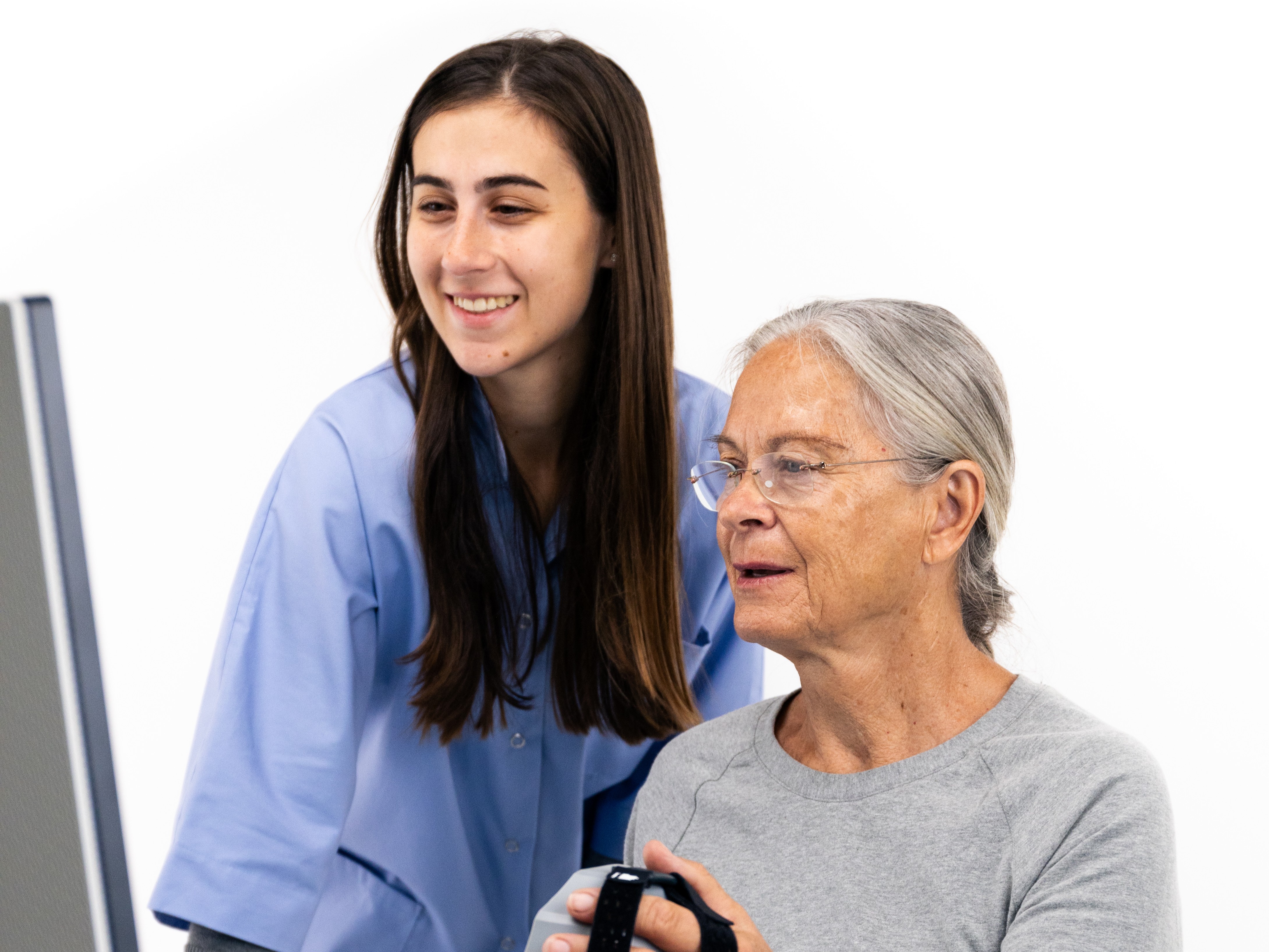
Traditional physiotherapy relies on periodic, subjective scales (like the Berg Balance Scale). While useful, these lack the granularity needed for daily optimization. Sensor-based technology—including tools like Equio and Bimeo—bridges this gap.
The Benefits of Objective Motion Tracking
| Feature | Traditional Therapy | Sensor-Based Therapy |
|---|---|---|
| Data Type | Qualitative (Visual observation) | Quantitative (Kinematic data) |
| Feedback | Delayed (Therapist’s verbal cue) | Instant (Real-time visual/audio) |
| Intensity | Low to Moderate repetitions | High-frequency (via Gamification) |
| Engagement | Manual/Repetitive | Interactive/Goal-oriented |
Key Metrics Tracked
- Movement Smoothness: Sensors detect “jerkiness” in upper-limb reaching, a direct indicator of motor control recovery [4].
- Weight Distribution: Platforms like Equio measure the Center of Pressure (CoP), identifying subtle weight-shifting patterns that lead to falls.
- Range of Motion (ROM): Digital tracking provides degree-perfect accuracy in shoulder and elbow flexibility.
4. Why Technology is the Catalyst for Neuroplasticity
The brain requires two things to rewire: Intensity and Salience (relevance).
- Intensity: Sensor-based systems allow patients to perform 5x to 10x more repetitions per session than traditional manual therapy.
- Salience: By using gamified interfaces, therapy becomes a rewarding challenge. This triggers dopamine release, which is a known chemical catalyst for neural remodeling and learning [5].
Conclusion: A New Standard of Care
The journey following a CVA is challenging, but survivors no longer have to navigate it in the dark. By utilizing objective assessments and motion-tracking technology, we can provide a roadmap of recovery that is visible, measurable, and highly effective.
🔍 References
- American Heart Association (2024). “Types of Stroke.” Heart.org.
- Kleim, J. A., & Jones, T. A. (2008). “Principles of experience-dependent neural plasticity.” Journal of Speech, Language, and Hearing Research.
- World Stroke Organization (2024). “Global Stroke Fact Sheet.”
- Balasubramanian, S., et al. (2024 update). “Kinematic assessment of arm movements after stroke.” Journal of NeuroEngineering and Rehabilitation.
- Levin, M. F., et al. (2025). “Motor learning in neurological rehabilitation.” Clinical Rehabilitation.
📺 Watch the Deep Dive
Want to see how sensor technology actually helps the brain rewire itself? Watch our detailed video guide here, where we explain the link between motion-tracking and neural recovery.
READY TO LEARN MORE
ABOUT OUR TOOLS?